In an everyday sense, love is usually defined as the measure of interpersonal affection that one may have for another. However, the definition gets more complicated when considering how the word is used in both romantic, platonic, and familial contexts, in addition to taking on a more divine or theological meaning in the context of worship and religion. Expanding upon this the Greeks had four words to broadly describe what we call love that are listed below,
- Eros – Romantic love
- Phileo – Friendship
- Storge – Family
- Agape – Unconditional love
Fundamentally, love is the binding force of all things, and underscores the interconnectedness of all things, that demonstrates that we are not just individual, isolated being but that we are all one in the cosmic sense; thereby, every action that one takes has an impact upon reality as we know it. Be that physically, emotionally, mentally, spiritually or otherwise. In fact Netwon’s third law of motion may even come to mind, which states that whenever two objects interact, they exert equal or opposite forces on each other.
In my opinion, if we liken love to a force as per Newton’s third law then we must acknowledge that this is an oversimplification, albeit it does broadly capture the essence of how our thoughts and actions impact upon one another, based on the love or lack thereof of love that underlies them. Additionally, love cannot be binary, for no-one can possess no love.
Even when we operate at the lowest vibrations or levels of consciousness the base of that love stems from concepts such as loyalty, love of your own family, friends, social group, religious or spiritual group, or love for ‘self’, which in itself at the basest level could really be interpreted as a love for who you think or are, or the various masks or habits we identify with.
At its peak the ‘energy’ of love is one of the highest vibrational frequencies that resonates in this universe, through every level of existence and consciousness, through every living and inanimate thing. Without it all would collapse and cease to exist. In essence the force of love is life, or the fullness of life at its zenith, also referred to as ever-lasting life in some religions.
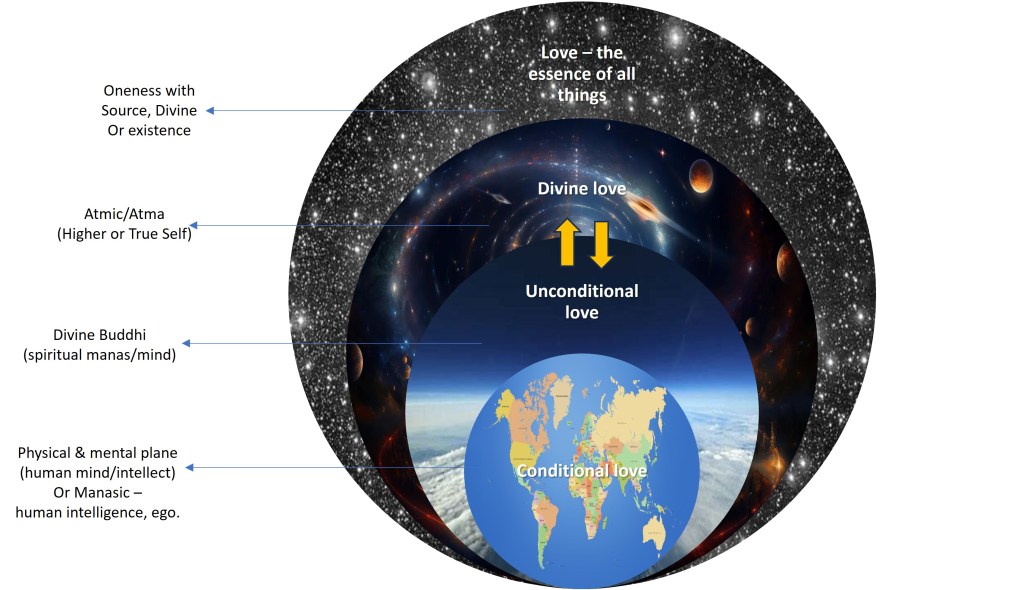
Referring to the above diagram and the Greek definitions provided earlier, conditional love would align with familial, romantic, and platonic (friendship) love. Everyone everyday operates with conditional love, the reasons for which range between common survival and ancestry at the most surface level to forming relationships with those who share common beliefs and world views, including romantic partners.
In this sense of the word love (or the quantity thereof) is only conditional on those who share the same beliefs and opinions, and our affection and compassion comes with a price. This type of love is most familiar with the ego, identity, and intellect and most known to society and popular thought.
Beyond this unconditional love may be aligned with agape love, which extends beyond intellect and ego and requires no rhyme, reason, or price.
It is beyond our opinions and beliefs and therefore beyond judgement. This is the aspirational love of humanity at present and is the type of love that spirituality, and various religious and mythical figures typically exemplify, or at least may have originally exemplified in their inception.
It is worth noting that the greatest understanding of these narratives commences with self-realisation or self-love that allows one to freely love others.
This is the difference between belief systems that foster relationships with Source, the Mother, the Father, as our Self (being that we are one), and those that foster unworthiness, guilt, and external dependency upon another figure or being.
At this point is where I believe that we move from the human mind or ego to the Divine mind as part of our Higher Self, where the ‘bridge’ or ‘ladder’ exists between the human/material and the Divine aspects of ourselves, where information is transmitted from the Higher Self to the human self and filtered through our own belief systems, teachings, opinions and biases that obscure our ability to practice unconditional love.
Beyond this point we then see that all is one, but as idealistic and wonderful this sounds few throughout creation on the earth have been able to attain this. Furthermore, such a state is virtually impossible to sustain and impractical to stay within all the time in our current world, given the requirements of living and working within the world.
However, this does not mean we should not make every effort to work towards unconditional love individually and collectively, knowing that all will move towards unconditional love according to their own capacity, circumstances, timescales, choices, and karma.

 The Philosopher's Poet